
The Arab world was watching largely in silence on Saturday as the United States and Iran fought what amounted to a battle for regional dominance in the Gulf, with Arab states caught between their American security relationships and the escalating Iranian military pressure. No major Arab government had publicly taken sides in the conflict, even as Iranian missiles struck the UAE’s Fujairah oil port and US warplanes continued bombing Iranian territory. The silence reflected the impossible position of governments that depended on the US for security but shared a neighbourhood — and in many cases economic ties — with Iran.
Iran’s foreign minister directly challenged that silence on Saturday, calling on Arab states to expel US forces from their territory. He argued that the US security presence was the cause rather than the cure of regional instability, and that Arab nations that continued to host American military forces were making themselves targets. The UAE’s response — condemning Iran’s attacks as terrorism while maintaining restraint and seeking diplomacy — illustrated the limited options available to Gulf states that lacked the military power to defend themselves against Iran’s missile arsenal independently of American support.
US warplanes struck Kharg Island for the second consecutive day on Saturday. President Trump said in public remarks the island had been effectively demolished and called on China, France, Japan, South Korea, and the UK to send warships to the Strait of Hormuz. His appeal acknowledged that reopening the waterway, closed by Iran since February 28, might require multilateral support. Energy prices were approaching $120 per barrel. Israeli warplanes conducted dozens of raids inside Iran, killing at least 15 people in Isfahan. Iran fired rockets at Israel in return.
US Defence Secretary Pete Hegseth claimed Iran’s leadership was “desperate and hiding” underground and that the new supreme leader had been wounded. Iranian officials confirmed Khamenei’s injury but disputed its severity. The International Crisis Group assessed the regime as structurally intact. Iranian ballistic missiles continued to strike Gulf infrastructure, with Fujairah’s oil-loading operations suspended after Saturday’s attack. Iranian commanders warned civilians near UAE ports and US installations to evacuate, signalling more strikes might follow.
The war’s human and economic costs continued to mount. More than 1,400 Iranians had been killed in sustained bombing. Thirteen Israelis and roughly 20 Gulf residents had died. Lebanon’s crisis deepened, with 800 killed and 850,000 displaced from Israeli strikes on Hezbollah. Six US troops died in an aircraft crash in Iraq. The US embassy in Baghdad was struck, and Americans in Iraq were ordered to leave. The Arab world’s silence was understandable given the circumstances, but analysts warned it was becoming harder to maintain as the conflict drew every country in the region into its orbit.
Arab World Watches in Silence as Iran and US Fight for Regional Dominance
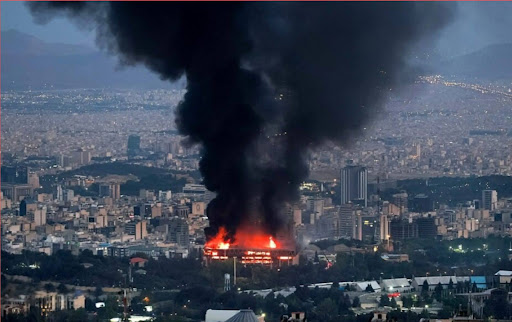
Photo by Mohammad Bornu / Avash Media / Wikimedia Commons (CC BY 4.0)
73